Human-Centered Design Approach for Developing an Aerospace Product Credit Sales Application: A System Usability Scale Evaluation
DOI:
https://doi.org/10.31848/jesii.v4i1.4775Keywords:
Application, Human Centered Design, Planning, Credit Sales, System Usability ScaleAbstract
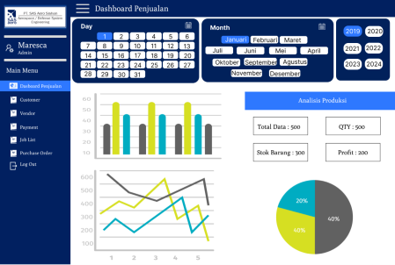
PT. SAS Aero Sishan faces challenges in monitoring production data and managing credit sales information efficiently, resulting in delayed decision-making processes. This study aims to design an aerospace product credit sales application using the Human-Centered Design (HCD) approach and evaluate its usability using the System Usability Scale (SUS). The research was conducted through four HCD stages: requirement gathering, analysis, prototype development, and evaluation. Data were collected through observation, interviews, documentation, and usability testing involving 30 respondents. The usability evaluation produced an average SUS score of 72.42, with descriptive statistics indicating a median score of 70, a minimum score of 50, a maximum score of 100, and a standard deviation of 13.14. The obtained SUS score falls into Grade B (Good), indicating that the proposed application provides acceptable usability and effectively supports users in managing credit sales activities. The findings demonstrate that applying the Human-Centered Design approach successfully accommodates user requirements and improves user satisfaction. This study contributes a user-centered framework for developing credit sales information systems in the aerospace industry and provides a practical reference for future usability-oriented system development.
References
I. A. Rouf and S. Royan, “Perancangan Dashboard Detail Downtime Oee Untuk Visualisasi dan Analisis Pada PT Xy,” Jupiter: Publikasi Ilmu Keteknikan Industri, Teknik Elektro dan Informatika, vol. 2, no. 1, pp. 147–157, Jan. 2024, doi: 10.61132/jupiter.v2i1.63.
M. Khairi et al., “PENGARUH TEKNOLOGI DALAM TRANSFORMASI EKONOMI DAN BISNIS DI ERA DIGITAL,” Feb. 2025.
Y. Pangestu, D. Yusuf, and G. H. Wibow, “KLIK: Kajian Ilmiah Informatika dan Komputer Implementasi Human-Centered Design dalam Perancangan Front-End Website Fundraising e-YM,” KLIK : Kajian Ilmiah Informatika dan Komputer, vol. 4, no. 6, pp. 2869–2880, Jun. 2024, doi: 10.30865/klik.v4i6.1899.
D. A. Andini and H. Ali, “Pengaruh Persaingan, Teknologi dan Perubahan Regulasi terhadap Strategi Keberhasilan Perusahaan,” JGIT (Jurnal Greenation Ilmu Teknik), vol. 2, no. 4, pp. 185–193, Jan. 2025, doi: 10.38035/jgit.v2i4.
R. F. Rochman, K. C. Brata, and H. Tolle, “Perbaikan Fitur Dashboard Skripsi di FILKOM APPS dengan menggunakan Pendekatan Human Centered Design,” Apr. 2022. [Online]. Available: http://j-ptiik.ub.ac.id
S. S. Kurniawan, N. Z. Maharani, D. I. Sensuse, E. H. Purwaningsih, and D. S. Hidayat, “Applying User Centered Design and System Usability Scale to Design Knowledge Management System for Exam Proctors in Higher Education,” Scientific Journal of Informatics, vol. 11, no. 4, pp. 1043–1056, Feb. 2025, doi: 10.15294/sji.v11i4.9919.
O. N. Faizah, N. R. Oktadini, B. W. Putra, P. E. Sevtiyuni, P. Putra, and A. Meiriza, “UI/UX Design of Web-based Software License Management System using User-Centered Design and System Usability Scale,” Jurnal Nasional Teknologi dan Sistem Informasi, vol. 9, no. 3, pp. 255–263, Jan. 2024, doi: 10.25077/teknosi.v9i3.2023.255-263.
L. Sa’adah, I. Muhimmah, and Y. Fitriyati, “Human Centered Design Dalam Perancangan Dashboard Ibu Hamil Di RS Universitas Islam Indonesia,” Jurnal Teknik Informatika dan Sistem Informasi, vol. 10, no. 1, pp. 741–756, Mar. 2023.
C. Damayanti, A. Triayudi, and I. D. Sholihati, “Analisis UI/UX Untuk Perancangan Website Apotek dengan Metode Human Centered Design dan System Usability Scale,” JURNAL MEDIA INFORMATIKA BUDIDARMA, vol. 6, no. 1, pp. 551–559, Jan. 2022, doi: 10.30865/mib.v6i1.3526.
F. Isnanto, M. A. Muhammad, and T. Yulianti, “RANCANG BANGUN SISTEM VISUALISASI DATA MENGGUNAKAN DASHBOARD PADA SISTEM DETEKSI HOAKS MELALUI PENDEKATAN HCD (HUMAN CENTERED DESIGN),” JITET (Jurnal Informatika dan Teknik Elektro Terapan), vol. 11, no. 3, pp. 806–814, Sep. 2023, doi: 10.23960/jitet.v11i3%20s1.3029.
Z. N. Muhammad, A. Meiriza, P. Putra, N. R. Oktadini, and P. E. Sevtiyuni, “KLIK: Kajian Ilmiah Informatika dan Komputer Perancangan Sistem Informasi Manajemen Aset Laboratorium Berdasarkan Pendekatan Human Centered Design (HCD),” KLIK : Kajian Ilmiah Informatika dan Komputer, vol. 3, no. 6, pp. 1272–1284, Jun. 2023, doi: 10.30865/klik.v3i6.797.
R. Gozalianto, B. Zaman, and H. P. Adys, “PERANCANGAN ULANG USER INTERFACE PADA APLIKASI JUST MEME MENGGUNAKAN METODE DESIGN THINKING,” Jurnal KHARISMA Tech, vol. 19, no. 1, pp. 139–152, Mar. 2024, [Online]. Available: https://jurnal.kharisma.ac.id/kharismatech
S. A. Wulandari and M. L. Hamzah, “ANALYZE THE LEVEL OF USEFULNESS OF THE NEWS RELEASE WEBSITE WITH USING THE SCALE USABILITY SYSTEM (SUS) METHOD,” Journal of Information Technology and Computer Science (INTECOMS), vol. 7, no. 1, pp. 290–298, 2024.
M. L. L. Usman and M. A. Gustalika, “Pengujian Validitas dan Reliabilitas System Usability Scale (SUS) Untuk Perangkat Smartphone,” Apr. 2022.
N. Huda, F. Habrizons, A. Satriawan, M. Iranda, and T. Pramuda, “Analisis Usability Testing Menggunakan Metode SUS (System Usability Scale) Terhadap Kepuasan Pengguna Aplikasi Shopee,” SIMKOM, vol. 8, no. 2, pp. 208–220, Jul. 2023, doi: 10.51717/simkom.v8i2.158.
Downloads
Published
How to Cite
Issue
Section
License
Copyright (c) 2026 Alis Susilawati, Erwin Teguh Arujisaputra, Adam Husain, Sri Erina Damayanti

This work is licensed under a Creative Commons Attribution-ShareAlike 4.0 International License.
Authors who publish in JESII: Journal Elektronik Sistem InformasI agree to the following terms:
Authors retain copyright and grant the journal right of first publication with the work simultaneously licensed under a Attribution-ShareAlike 4.0 International (CC BY-SA 4.0) License that allows others to share the work with an acknowledgment of the work's authorship and initial publication in this journal.
Authors are able to enter into separate, additional contractual arrangements for the non-exclusive distribution of the journal's published version of the work (e.g., post it to an institutional repository or publish it in a book), with an acknowledgment of its initial publication in this journal.
Authors are permitted and encouraged to post their work online (e.g., in institutional repositories or on their website) prior to and during the submission process, as it can lead to productive exchanges, as well as earlier and greater citation of published work (See The Effect of Open Access).