Web-GIS Architecture Blueprint for Multi-Category Cultural Heritage Mapping and Classification in Bandung City Using a Waterfall Approach
DOI:
https://doi.org/10.31848/jesii.v4i1.4707Keywords:
Geographic Information Systems, Cultural Heritage, Mapping, Classification, System DesignAbstract
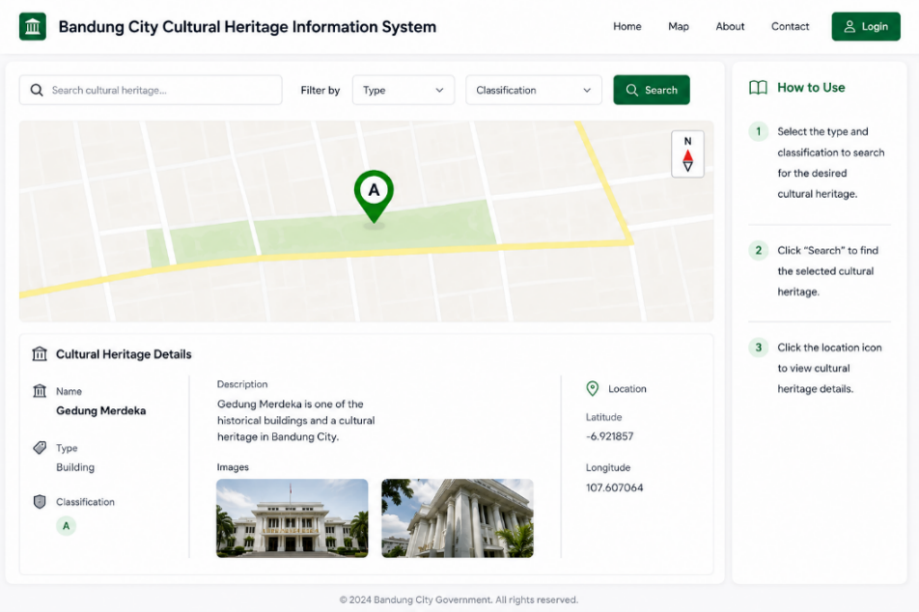
This study aims to design a blueprint for a web-based geographic information system (Web-GIS) architecture specifically designed for mapping and classifying high-intensity cultural heritage in Bandung City. Although Bandung has a very high number of heritage assets, its operational data remains fragmented, statistical, and textually protected across various scattered sources, which hinders real-time monitoring and increases structural vulnerability amidst rapid urban development. This study uses a descriptive method with a structural system design approach, requirements implementation analysis and system design phases of the Waterfall model based on the Pressman software engineering paradigm. The technical design uses Data Flow Diagrams (DFDs) and Entity Relationship Diagrams (ERDs) to organize a new multi-category data synchronization scheme in accordance with local regulations (Categories A, B, and C). The output of this study is a robust system architecture, database model, and user interface design validated through empirical alignment with the city registry and field observations. Initial testing of the interactive prototype, which included Black Box Testing across fifteen functional scenarios and a System Usability Scale (SUS) assessment involving five respondents, resulted in a 100% functional consistency rate and an average SUS score of 78.5 (“Acceptable”), indicating favorable initial usability. Rather than developing a fully operational Web-GIS platform, this study presents a validated architectural blueprint and interactive prototype that provide the technical basis for future full-scale operational implementation, deployment, and evaluation.
References
H. Kunto, Wajah Bandoeng Tempo Doeloe. Bandung: PT. Granesia, 1984.
S. K. Kartodiwirio, “Bandung Kilas Peristiwa di Mata Filatelis Sebuah Wisata Sejarah,” Bandung: PT Kiblat Buku Utama, 2006.
R. Hutagalung and T. Nugraga, BRAGA JANTUNG PARIJS VAN JAVA. Ka Bandung, 2008.
UNESCO, “Intangible Cultural Heritage and Sustainable Development,” 2015.
UNESCO, “Policy Document for the Integration of a Sustainable Development Perspective into the Processes of the World Heritage Convention,” 2015. [Online]. Available: http://whc.unesco.org/en/documents/1334
Peraturan Daerah Kota Bandung Nomor 7 Tahun 2018 tentang Pengelolaan Cagar Budaya.
Peraturan Daerah Kota Bandung Nomor 6 Tahun 2025 tentang Pengelolaan dan Pelestarian Cagar Budaya.
Dinas Kebudayaan DKI Jakarta, “Penetapan Cagar Budaya Tahun 2025.” Accessed: May 01, 2026. [Online]. Available: https://dinaskebudayaan.jakarta.go.id/page/521/2840
K. dan O. serta P. K. S. Dinas Kebudayaan, “Data Cagar Budaya Kota Surabaya.” Accessed: May 01, 2026. [Online]. Available: https://disbudporapar.surabaya.go.id/adinda/portaldata
H. DH, 100 Bangunan Cagar Budaya di Bandung. Bandung: CSS Publishing, 2011.
G. Amalia, H. M. Tati, and U. Dewi, “Information System Of The Spread Of Potential And Investment Opportunities Of The Natural Stone, Batik And Rattan Industry From Cirebon District Using A Geographic Information System,” JUPITER : Jurnal Penelitian Mahasiswa Teknik Dan Ilmu Komputer, vol. 1, no. 2, 2021.
Y. Huang, “Bibliometric analysis of GIS applications in heritage studies based on Web of Science from 1994 to 2023,” Dec. 01, 2024, Springer Science and Business Media Deutschland GmbH. doi: 10.1186/s40494-024-01163-y.
V. Ducatteeuw, F. Danniau, and C. Verbruggen, “Mapping Ghent’s cultural heritage: a place-based approach with web GIS,” International Journal of Digital Humanities, vol. 7, no. 1, pp. 91–113, Mar. 2025, doi: 10.1007/s42803-025-00099-4.
J. T. Santoso, G I S, SISTEM INFORMASI GEOGRAFIS. Yayasan Prima Agus Teknik, Universitas STEKOM, 2021.
R. S. Pressman and B. R. Maxim, Software Engineering, 9th ed. McGraw-Hill Education, 2020.
Downloads
Published
How to Cite
Issue
Section
License
Copyright (c) 2026 Farly Mochamad

This work is licensed under a Creative Commons Attribution-ShareAlike 4.0 International License.
Authors who publish in JESII: Journal Elektronik Sistem InformasI agree to the following terms:
Authors retain copyright and grant the journal right of first publication with the work simultaneously licensed under a Attribution-ShareAlike 4.0 International (CC BY-SA 4.0) License that allows others to share the work with an acknowledgment of the work's authorship and initial publication in this journal.
Authors are able to enter into separate, additional contractual arrangements for the non-exclusive distribution of the journal's published version of the work (e.g., post it to an institutional repository or publish it in a book), with an acknowledgment of its initial publication in this journal.
Authors are permitted and encouraged to post their work online (e.g., in institutional repositories or on their website) prior to and during the submission process, as it can lead to productive exchanges, as well as earlier and greater citation of published work (See The Effect of Open Access).